AI-powered call analytics: How to extract insights from customer conversations
Learn how to extract actionable insights from customer conversational data with AI-powered call analytics tools and features


Customer conversational data offers a wealth of insights that often sit untouched by most companies. However, this is changing, with a Gartner prediction stating that by 2025, 60% of organizations will analyze voice and text interactions to supplement traditional surveys. If the data is analyzed, it is typically performed manually, resulting in small sample sizes (less than 5% of all conversational data available) that make it difficult to extrapolate broader findings and apply these findings to make informed business decisions.
This inefficient process is one of the reasons why top companies today are turning to AI-powered call analytics tools to help them sift through their gigabytes of customer data and to perform intelligent analysis on top of that data to improve quality monitoring, discover customer insights around brand strength or potential risks, and increase agent performance and productivity.
Here we examine how companies are building AI-powered call analytics tools and features using Voice AI models such as Automatic Speech Recognition (speech-to-text), speech understanding models, and Large Language Models, as well as some of the top benefits and use cases for integrating Voice AI.
What is call center analytics
Call center analytics is the systematic analysis of customer conversation data to improve operational efficiency, agent performance, and customer satisfaction. Modern AI-powered systems analyze 100% of calls automatically, a significant leap from traditional manual methods. For instance, internal analysis shows that managers using traditional sampling can typically only review about 1-3% of calls.
This transformation from manual sampling to comprehensive analysis allows companies to identify trends, optimize processes, and make data-driven decisions that directly impact business outcomes.
Key metrics and KPIs for call center analytics
While AI unlocks deeper insights, call center analytics are still grounded in key performance indicators (KPIs). Tracking these metrics helps measure the impact of your efforts. Common KPIs include:
- First Contact Resolution (FCR): The percentage of customer issues resolved on the first call. A higher FCR is a strong indicator of customer satisfaction and operational efficiency, and McKinsey research demonstrates that implementing GenAI can increase first-call resolution rates by 10 to 20 percentage points.
- Average Handle Time (AHT): The average duration of a single customer interaction, from initiation to post-call work. The goal is to reduce AHT without sacrificing service quality, and AI tools are proving effective. In fact, research on AI assistance indicates that platforms integrating real-time agent support see an average 27% reduction in call handle time.
- Customer Satisfaction (CSAT): A direct measure of how happy customers are with the service they received, typically captured through post-call surveys. The impact of conversation intelligence on this metric is significant, with a recent market survey finding that over 70% of companies reported a measurable increase in end-user satisfaction after implementation.
- Agent Compliance: Ensures agents adhere to scripts, regulatory requirements, and internal quality standards during calls.
- Sentiment Analysis: Tracks the emotional tone of the customer and agent throughout the conversation to identify friction points and coaching opportunities.
Types of call center analytics
Call center analytics can be broken down into four types, each answering a progressively more complex question.
1. Descriptive Analytics: What happened?
This is the most basic form, providing a summary of past data. Think of dashboards showing call volume, average wait times, and AHT.
2. Diagnostic Analytics: Why did it happen?
This goes a step deeper to understand the root cause of the data. For example, why did AHT spike last Tuesday? Diagnostic analytics might reveal it was due to a new marketing campaign causing complex customer queries.
3. Predictive Analytics: What will happen?
Using historical data and AI models, this type of analytics forecasts future trends. It can predict things like future call volumes, or which customers are at the highest risk of churning.
4. Prescriptive Analytics: What should we do about it?
This is the most advanced form. It not only predicts what will happen but also recommends specific actions to take. For example, it might suggest a real-time script for an agent to use with a customer who is predicted to be a churn risk.
What are the benefits of AI-powered call analytics?
AI-powered call analytics use Voice AI models to automate previously manual processes and serve intelligent, actionable insights to companies.
Any company that processes large amounts of customer data—like call centers, contact centers, and sales intelligence platforms—can integrate AI-powered call analytics tools and features into their workflows to realize numerous benefits, including:
- More efficiently reviewing sales calls at scale to flag turns in conversational tone or to analyze most/least effective talking points
- Speeding up QA to identify trends more accurately and forecast future moves
- Reducing manual tasks to increase representative and customer engagement
- Summarizing calls at scale
- Enabling more efficient context-sharing between team members
- Optimizing overall call or contact center performance, and more.
Using Voice AI to extract insights from customer conversations
Voice AI transforms raw customer conversations into structured business intelligence through four core technologies.
These AI models work together to automate analysis that previously required manual review, enabling companies to process every customer interaction at scale.
Automatic Speech Recognition (ASR)
Automatic speech recognition, or ASR, models transcribe human speech (from audio or video files) into readable text. ASR models are also referred to as speech-to-text AI.
ASR can occur synchronously with real-time transcription models or asynchronously, transcribing previously recorded audio or video. Today's ASR models, like Universal, are informed by state-of-the-art AI research and trained on enormous datasets to achieve near-human levels of accuracy.
Large Language Models (LLMs)
Large Language Models, or LLMs, enable users to build high-quality Generative AI and speech analysis tools on top of available voice data.
LLM Gateway
AssemblyAI's LLM Gateway is a framework for applying Large Language Models (LLMs) to spoken data. It helps unify your Voice AI application stack across speech-to-text, speech understanding, and LLM insights into one platform.
For conversational data, this means users can:
- Change the custom summary to highlight what went well/didn't go well during a call.
- Summarize the pricing aspect of a conversation, or highlight key pain points.
- Analyze findings from the aggregated data across all agent-customer conversations to inform strategic decisions about agent training, branding, and customer satisfaction.
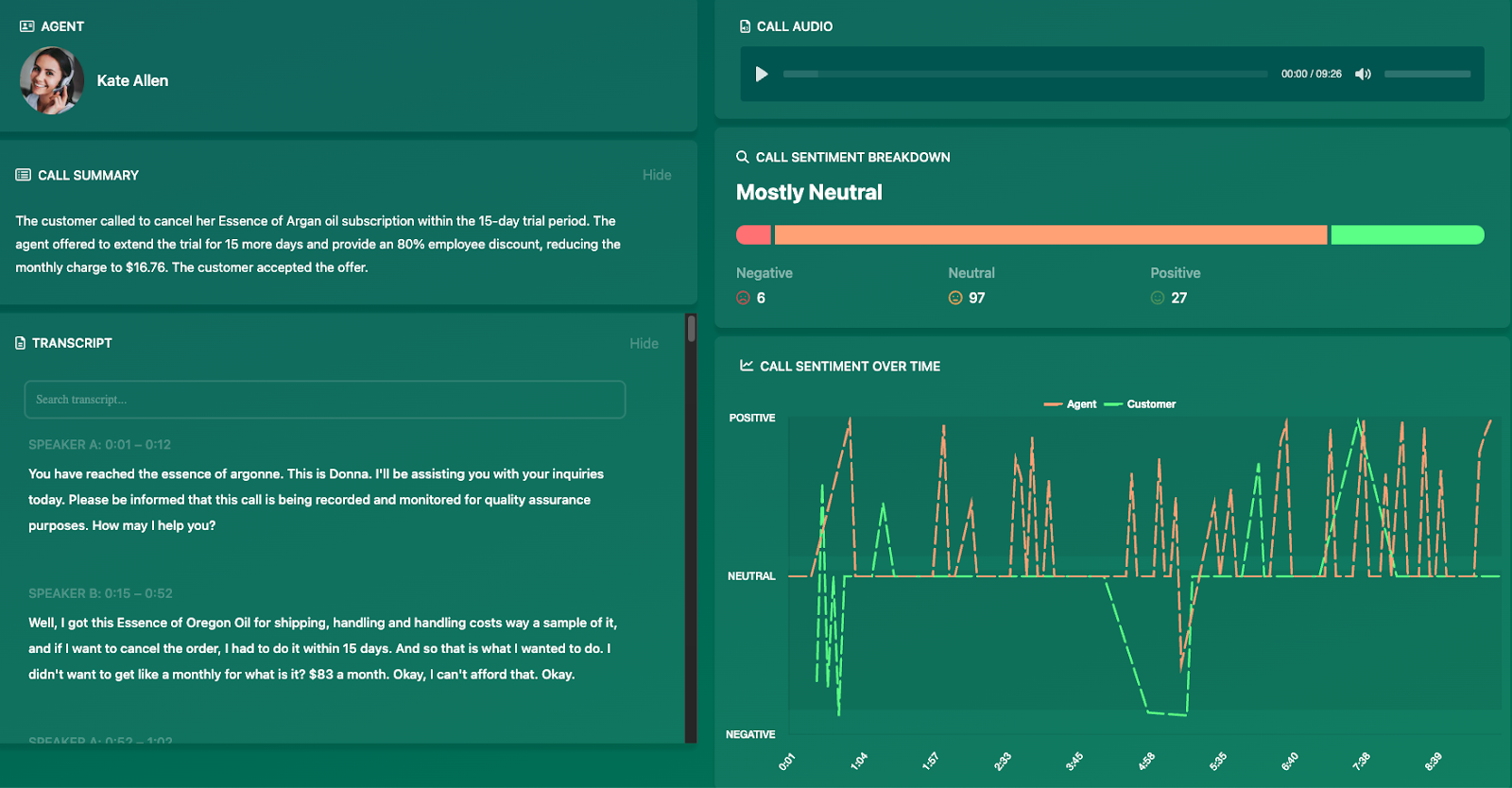
Additional endpoints can also generate action items following a phone call, or provide answers to specific questions about agent-customer interactions.
Speech Understanding
Speech Understanding models, also sometimes referred to as Audio Intelligence models, help users unlock critical information from spoken data. Speech Understanding models can include Sentiment Analysis, Summarization, Topic Detection, Entity Detection, and more.
Real-world Voice AI use cases for call analytics
CallRail is a lead intelligence software company that has embraced AI into its platform, helping its customers build more meaningful relationships on sales calls and significantly increase ROI on call tracking.

Source: CallRail
For example, its AI Conversational Intelligence feature auto-scores and categorizes key sections of customers' calls, helping users more efficiently and intelligently process call data at scale. With the addition of this feature and other AI-powered tools, CallRail was able to double the number of customers using its Conversational Intelligence product.
As a Generative AI-based Conversation Intelligence platform, Pathlight helps companies automate conversational data analysis using Generative AI tools and features. With the Pathlight platform, users can transcribe every conversation that takes place and perform an enhanced analysis on top of the transcription data to extract insights, themes, and trends.

Source: Pathlight
Pathlight users have seen impressive results. One customer increased their enterprise sales performance by 53% and another customer sped up QA reporting by 66%.
Jiminny is a leading Conversation Intelligence, sales coaching, and call recording platform that provides mission-critical support to sales and customer success teams.

Source: Jiminny
The platform's advanced Voice AI tools, including tools for custom summaries, data-driven coaching, forecasting, customer persona, and more, help their customers achieve a 15% higher win rate, on average.
Implementation strategies for call center analytics
Successfully implementing call center analytics isn't just about choosing a tool; it's about having a clear strategy. Here's a simple approach:
- Define Your Goals: Start by identifying the key business problem you want to solve. Are you trying to reduce customer churn, improve agent training, or increase FCR? Clear goals will guide your entire strategy.
- Integrate Your Data: You need a reliable way to access your call data. Modern Voice AI platforms offer flexible APIs that can easily integrate with your existing call recording systems and data warehouses.
- Choose the Right Technology: Decide whether to build a custom solution or buy an off-the-shelf product. An API-first approach, like AssemblyAI's, gives you the flexibility to build custom analytics features that fit your exact needs without the massive R&D investment of building your own AI models.
- Train and Empower Your Team: An analytics platform is only as good as the people using it. Ensure your managers and agents are trained on how to interpret the data and use the insights to make better decisions.
- Measure and Iterate: Continuously track your KPIs to measure the impact of your analytics program. Use the insights to refine your processes, improve agent coaching, and drive ongoing business value.
Lorem ipsum dolor sit amet, consectetur adipiscing elit, sed do eiusmod tempor incididunt ut labore et dolore magna aliqua. Ut enim ad minim veniam, quis nostrud exercitation ullamco laboris nisi ut aliquip ex ea commodo consequat. Duis aute irure dolor in reprehenderit in voluptate velit esse cillum dolore eu fugiat nulla pariatur.
Related posts