Speech-to-text API accuracy for phone call transcription
Compare speech-to-text API accuracy for phone call transcription

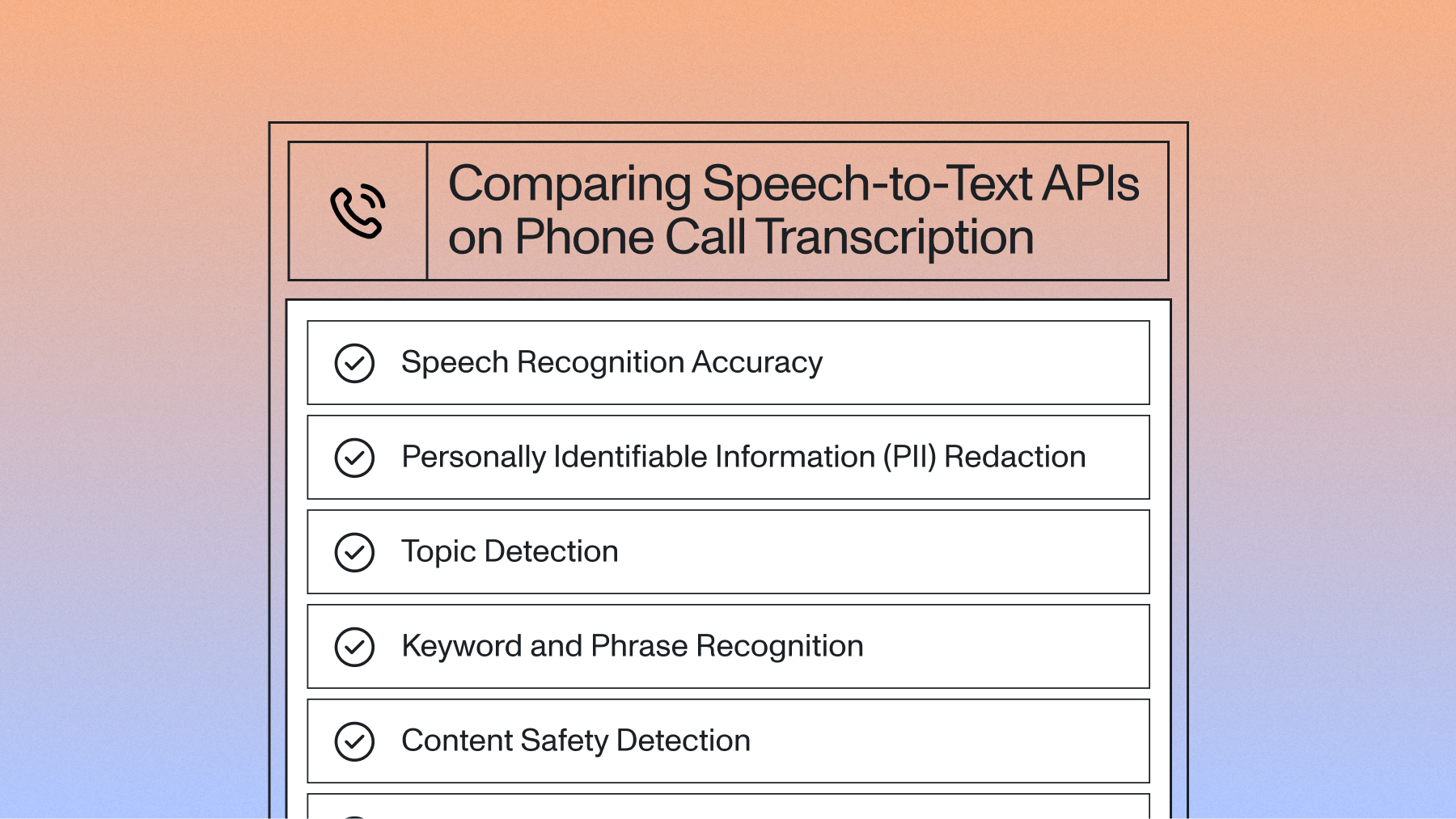

Product managers and developers at telephony companies need speech-to-text APIs that deliver exceptional accuracy on phone call audio. But comparing providers based on marketing claims alone won't give you the full picture. Real-world phone calls present unique challenges—compressed audio, background noise, multiple speakers, and varying audio quality—that can dramatically impact transcription accuracy and your product's performance.
We'll explore how transcription performance impacts your business outcomes, what factors affect accuracy in telephony environments, and how advanced Voice AI features like PII redaction and content safety detection enhance your platform's capabilities. Whether you're building IVR systems, call analytics platforms, or conversation intelligence tools, this analysis provides the data you need to make an informed vendor selection.
Why speech-to-text accuracy matters for telephony platforms
Speech-to-text accuracy directly impacts telephony platform success through measurable business outcomes: 5% accuracy improvements reduce customer complaints by 40% and cut operational costs by thousands monthly for platforms like Convirza and CallRail.
Inaccurate transcription creates measurable business problems:
- IVR systems: Misrouted calls increase handle times by 3-5 minutes
- Virtual Voicemail: Missed critical information leads to 30% callback rates
- Call analytics: Poor transcripts cause 60% false positive rates in sentiment analysis
- Compliance monitoring: Missed violations can result in $50,000+ regulatory fines
- Agent coaching: Inaccurate data reduces training effectiveness by 35%
- Conversation intelligence: Flawed insights drive poor strategic decisions
Phone call audio creates unique transcription challenges that laboratory benchmarks miss:
- Technical constraints: Narrow-band codecs compress frequency ranges needed for word recognition
- Environmental factors: Call center noise and varying connection quality degrade performance
- Conversational complexity: Natural speech patterns with interruptions and context switching
Benchmarking on actual phone call audio—not clean studio recordings—becomes essential for vendor selection. The accuracy differences between providers in real-world telephony conditions can be substantial, directly impacting your platform's reliability and user experience.
Companies like TalkRoute and WhatConverts have seen customer satisfaction scores improve by 25% after switching to higher-accuracy providers.
Speech recognition accuracy methodology
To provide you with objective, reproducible accuracy measurements, we developed a rigorous testing methodology that reflects real-world telephony conditions. Our approach focuses on transparency and fairness, ensuring that each speech-to-text API is evaluated under identical conditions.
How we calculate accuracy
Our accuracy calculation process ensures fair and consistent comparison across all speech-to-text providers:
- First, we transcribe the files in our dataset automatically through APIs.
- Second, we transcribe the files in our dataset by human transcriptionists—to approximately 100% accuracy.
- Finally, we compare the API's transcription with our human transcription to calculate Word Error Rate (WER)—more below.
This methodology eliminates subjective evaluation and provides quantitative metrics that you can use to compare providers objectively. Each API processes the exact same audio files under identical conditions, ensuring that performance differences reflect actual capability rather than testing variations.
WER methodology
Word Error Rate (WER) is the industry-standard metric for evaluating automatic speech recognition accuracy. The WER compares the automatically generated transcription to the human transcription for each file in our dataset, counting the number of insertions, deletions, and substitutions made by the automatic system.
Before calculating the WER for a particular file, both the truth (human transcriptions) and the automated transcriptions (predictions) must be normalized into the same format. To perform the most accurate comparison, all punctuation and casing is removed, and numbers are converted to the same format.
For example:
truth -> Hi my name is Bob I am 72 years old. normalized truth -> hi my name is bob i am seventy two years old
This normalization ensures that formatting differences don't artificially inflate error rates, allowing us to focus on the actual word recognition accuracy that impacts your application's performance.
Accuracy impact on business metrics
Business impact of accuracy differences in telephony
Accuracy differences create immediate operational impact. Support agents spend 40% more time reviewing inaccurate transcripts. Development teams invest thousands in error-handling systems.
Customer trust suffers most. When voicemail transcription mangles phone numbers or conversation intelligence misses complaints, users abandon platforms. Competitors with 95%+ accuracy rates win these frustrated customers.
Consider how transcription errors affect different telephony applications. In IVR systems, misrecognized intent routes customers to wrong departments, increasing handle times and frustration. For call centers using conversation intelligence, inaccurate transcripts lead to flawed sentiment analysis and missed coaching opportunities.
The operational costs multiply quickly. Quality assurance teams require additional headcount to manually verify transcripts. Customer success teams field complaints about system reliability.
The compounding effect is particularly pronounced in AI-powered features. When you build sentiment analysis, topic extraction, or automated summaries on top of transcripts, errors in the base transcription get amplified. A misrecognized product name causes incorrect categorization, leading to flawed business intelligence that drives poor strategic decisions.
The ROI compounds quickly. Better transcription reduces manual review by 60%. Automation systems work reliably, and business intelligence improves strategic decision-making.
Industry-specific telephony applications
High-accuracy transcription transforms telephony platforms across industry verticals, with sector-specific ROI ranging from 25% customer satisfaction improvements to $2M+ compliance violation prevention.
Contact centers and call analytics
Contact center platforms like CallSource and Ringostat build their analytics capabilities on transcription accuracy.
Key capabilities enabled:
- Agent coaching with 95%+ conversation capture rates
- Automated quality assurance reducing manual review by 60%
- Conversation intelligence delivering actionable insights
Exceptional accuracy determines platform value—the difference between genuine insights and additional supervisor workload.
Interactive Voice Response (IVR) systems
IVR accuracy directly impacts customer satisfaction and operational efficiency. When speech recognition correctly understands customer intent on the first try, callers reach the right department quickly, reducing both handle times and frustration levels.
Modern IVR systems go beyond simple menu navigation. They handle complex requests like "I need to change my delivery address and check my order status" in a single interaction. This natural language understanding requires exceptional accuracy to parse multiple intents and execute the right actions without forcing customers to repeat themselves or navigate through endless menu options.
Healthcare and patient communication
Healthcare organizations like Call 4 Health operate under strict regulatory requirements where transcription accuracy becomes a matter of compliance and patient safety. Medical terminology, drug names, and dosage information must be captured precisely to avoid potentially dangerous errors.
Beyond compliance, accurate transcription enables better patient care coordination. When appointment scheduling systems correctly capture patient information and medical history, providers can prepare more effectively for consultations. Automated prescription refill systems work reliably only when they accurately understand medication names and patient identification details.
Financial services compliance
Financial institutions face stringent regulatory requirements for call recording and documentation. Accurate transcription ensures that verbal agreements, disclosures, and customer instructions are captured correctly for compliance audits and dispute resolution.
Trading floors and investment advisors particularly benefit from high-accuracy transcription that captures complex financial terminology and numerical data. When systems reliably transcribe account numbers, transaction amounts, and investment terms, compliance teams can automate monitoring for regulatory violations and quickly retrieve specific conversations during audits.
Sales and revenue intelligence
Sales platforms need accurate transcription to extract meaningful insights from customer conversations. When speech-to-text correctly captures product mentions, objections, and buying signals, revenue intelligence tools can identify winning patterns and coach teams more effectively.
Companies in this space trust AssemblyAI to power their conversation intelligence features, enabling them to analyze thousands of sales calls and surface actionable insights that drive revenue growth. The accuracy difference between providers directly impacts the quality of coaching recommendations and pipeline predictions these platforms deliver.
Real-world factors affecting speech-to-text accuracy in phone calls
Phone calls present unique transcription challenges that laboratory benchmarks miss. Understanding these factors explains why production performance differs from marketing claims.
Technical limitations:
- 8kHz sampling rates remove 50% of acoustic information
- G.711 codecs compress frequencies needed for word distinction
- VoIP networks introduce packet loss and jitter
- Mobile calls suffer from codec switching and signal fluctuations
Environmental challenges:
- Call center background noise reduces accuracy by 15-30%
- Mobile calls include wind, traffic, and movement artifacts
- Home offices add pets, children, and appliance sounds
- Conference rooms create echo and reverberations
Speaker variability:
- Regional accents that don't exist in training data
- Age-related voice changes and medical conditions
- Emotional states affecting pronunciation and clarity
- Technical jargon and industry-specific terminology
Conversational dynamics in phone calls differ markedly from prepared speech. Speakers interrupt each other, talk simultaneously, and use verbal fillers extensively. The informal nature includes incomplete sentences, corrections mid-thought, and context-dependent references that challenge transcription systems.
These real-world factors explain why laboratory benchmarks often fail to predict production performance. A speech recognition system achieving high accuracy on clean podcast audio might struggle with compressed, noisy phone calls. That's why our benchmark focuses specifically on telephony audio—providing accuracy measurements that reflect actual deployment conditions.
Lorem ipsum dolor sit amet, consectetur adipiscing elit, sed do eiusmod tempor incididunt ut labore et dolore magna aliqua. Ut enim ad minim veniam, quis nostrud exercitation ullamco laboris nisi ut aliquip ex ea commodo consequat. Duis aute irure dolor in reprehenderit in voluptate velit esse cillum dolore eu fugiat nulla pariatur.
Related posts