This article examines what exactly conversational intelligence AI is, how conversational intelligence AI works, some of its main benefits and challenges, top use cases and tools, and what is next for the field.
With the massive amount of digital conversational data available—from virtual meetings to call centers to chatbots—it's no surprise that enterprises are looking to AI to help make sense of this information overload. One area that is rapidly growing to meet this demand is Conversational Intelligence AI.
This article examines what exactly Conversational Intelligence AI is, the business impact it delivers, how the technology works, its main benefits and challenges, top use cases across industries, and guidance on choosing the right solution for your organization.
What is conversational intelligence AI?
Conversational Intelligence AI extracts actionable business insights from conversational data using advanced AI models. It analyzes sales calls, customer service interactions, and meetings to identify patterns, opportunities, and coaching moments automatically.
What's the difference between conversational intelligence AI and conversational AI?
Conversational Intelligence AI is different from Conversational AI, which refers to technology that imitates human conversations, such as virtual agents or website chatbots. However, some similarities exist: they both process large amounts of data and are built using the latest AI models and Natural Language Processing (NLP) research.
Business impact and ROI of conversational intelligence AI
Conversational intelligence AI transforms raw conversation data into measurable business outcomes. By analyzing every customer interaction, companies can move from anecdotal evidence to data-driven strategies that directly impact the bottom line.
The primary business value breaks down into three key areas:
Organizations implementing conversational intelligence AI see measurable improvements within months:
Customer service teams: Reduced average handle times while maintaining quality
Sales organizations: Increased quota attainment and faster deal velocity
Healthcare providers: Less documentation burden, improved patient care
Companies like CallRail doubled their conversation intelligence customer base, while Screenloop reduced manual hiring tasks by 90% for customers. These results demonstrate the compound effect of AI-driven insights on business performance.
How does conversational intelligence AI work?
Conversational Intelligence AI is a multi-step process.
First, conversational data is captured via audio and video inputs, such phone calls, virtual meetings, or presentations.
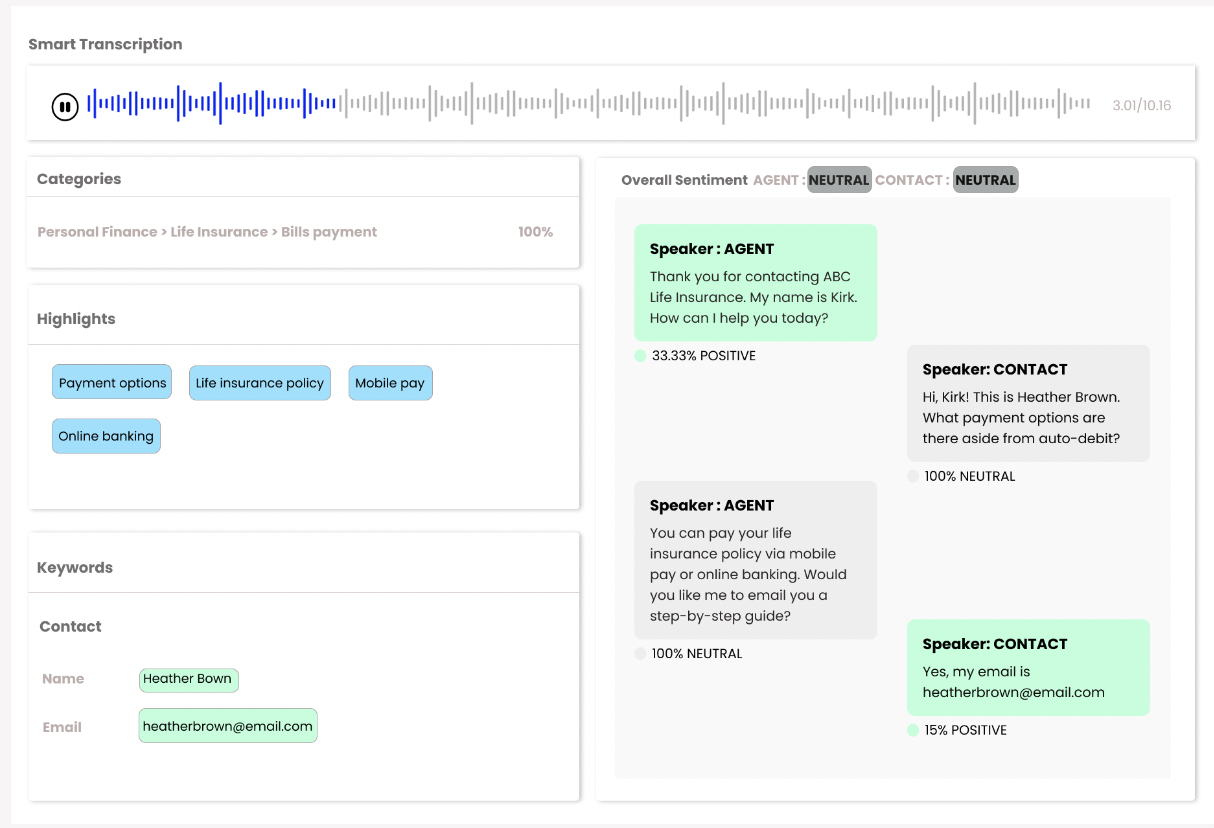
Then, the conversation is transcribed via a speech-to-text model.
Next, AI analysis is performed via LLMs or additional AI models such as summarization or sentiment analysis.
Finally, these in-depth analyses are used to inform actionable insights.
Test Conversational Intelligence Models
Try summarization, sentiment, and topic detection on your own audio in our no-code Playground. See how AI turns conversations into actionable insights.
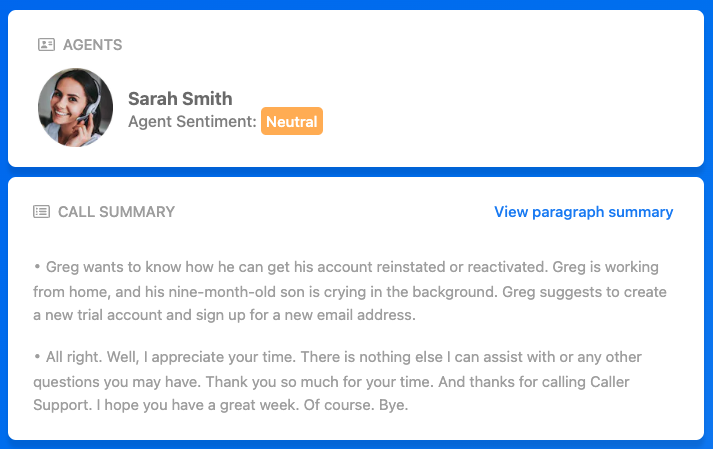
AI Summarization models can distill large bodies of text, like transcribed phone calls, into their most important parts. The most robust AI Summarization models are trained on data highly relevant to their use case—such as conversational data—to provide useful summaries across all aggregate conversational data.
Companies then build tools and features on top of these summaries that use this data to help their customers more efficiently review large amounts of call data, increase customer and representative engagement, and enable more informed context sharing.
Sentiment Analysis AI models can detect and label positive, negative, and neutral sentiments in a text. Product teams use Sentiment Analysis models to build tools that flag changes in sentiment during a conversation that could suggest potential red flags, buying indicators, and more so that sales teams can make more informed decisions, agents can be better trained to handle problems, and more.
In addition, Topic Detection AI models can identify topics in a conversation such as clothing or weather and Entity Detection AI models can identify and classify recurring entities such as occupation or location that occur during a conversation. Product teams use Topic Detection and Entity Detection models to build Conversational Intelligence tools that identify trends in conversations that can in turn inform strategy and increase ROI.
Finally, product teams are also building Generative AI tools with Large Language Models (LLMs) to make even more robust and customizable Conversational Intelligence AI tools. For example, a framework for applying LLMs to speech data, LLM gateway lets users use their LLM of choice to fully customize their meeting summaries instead of outputting a one-size-fits-all summary.
What are the benefits of conversational intelligence AI?
Teams implementing conversational intelligence AI report measurable improvements:
90% reduction in manual note-taking time
50% faster conversation review and analysis
30% improvement in coaching effectiveness
25% increase in sales conversion rates
40% reduction in quality assurance time
Real-time identification of buying signals and risks
Automated scoring, tagging, and qualifying of calls
What are the top use cases for conversational intelligence AI?
Sales Intelligence
Sales teams use Conversational Intelligence AI to analyze customer interactions and improve performance. The technology helps identify successful patterns, provides coaching opportunities, and increases win rates.
For example, CallRail is a call tracking and marketing analytics software company that uses an AI-first approach to inform its product strategy, including its Conversational Intelligence tools. CallRail partnered with AssemblyAI, an AI company that integrates production-ready AI models built using the latest state-of-the-art AI research, including models for call transcription, Sentiment Analysis, and Summarization. The call tracking company then built robust Conversational Intelligence AI tools on top of these AI models that provide high value for their numerous customers.
Contact Centers as a Service
Support teams leverage Conversational Intelligence AI to monitor customer satisfaction, improve service quality, and identify trending issues.
For example, as a Contact Center Software as a Service, Aloware uses Conversational Intelligence AI to help companies more efficiently convert leads. The company's Conversational Intelligence offering consists of features built using AI models for smart call transcription and AI Summarization, which together help their customers more quickly and intelligently perform QA. Aloware also built features using Sentiment Analysis models to help their customers more easily track their users' opinions and feelings across various metrics.
Upgrade Your Contact Center Insights
See how AssemblyAI powers QA automation, sentiment tracking, and trend detection for support teams. Discuss integration paths tailored to your contact center.
Organizations use Conversational Intelligence AI to capture and analyze meeting content, automatically extract key points, and create searchable knowledge bases.
Choosing the right conversational intelligence solution
Selecting the right conversational intelligence foundation directly impacts your application's success. Implementation typically takes 2-4 weeks with the right platform versus 6-12 months building in-house.
Key evaluation criteria:
Accuracy: Look for 95%+ speech recognition accuracy across diverse audio conditions
Scalability: Must handle thousands to millions of hours without performance degradation
Security: SOC2 Type 2 certification and HIPAA compliance support
Integration: Well-documented APIs for rapid development cycles
This often leads to a 'build vs. buy' decision. While building in-house offers control, it requires significant, ongoing investment in specialized research and engineering talent. Partnering with a Voice AI platform, as companies like CallRail and Veed have done, accelerates time-to-market and provides access to continuous innovation from a dedicated AI research team.
The most successful implementations start with a clear understanding of your specific use cases and requirements. Consider factors like expected conversation volume, types of conversations to analyze, your team's technical capabilities, and budget constraints. Companies that take a strategic approach—evaluating both technical capabilities and business alignment—consistently achieve better outcomes than those who focus solely on feature checklists or pricing.
What are the challenges of conversational intelligence AI?
Conversational Intelligence AI is informed by some of the most cutting-edge, state-of-the-art research available. However, the field is innovating rapidly and some challenges do remain.
One of the biggest challenges for companies looking to build Conversational Intelligence tools is keeping up-to-date with the latest innovations in AI. The field of AI is moving at an unprecedented pace and companies will need to prioritize creating Conversational Intelligence tools built using state-of-the-art research, or risk customer churn.
Thankfully, companies can often mitigate this potential challenge by partnering with an AI company that provides scalable, secure, production-ready AI models built using the latest AI research. Companies can then rely on this partner's internal AI research team to iterate based on new research developments and innovation. In turn, companies can then know that the AI models that they integrate into their products will be continuously state-of-the-art.
Looking forward: What's next for conversational intelligence AI?
The field of Conversational Intelligence AI will continue to innovate and progress rapidly, in line with concurrent progress in the field of AI in general. Advances in AI research will provide further opportunities for companies to build competitive Conversational Intelligence AI products that unlock enormous amounts of value for their customers.
As this research progresses, AI models that inform Conversational Intelligence, such as transcription, Summarization, Sentiment Analysis, Topic Detection, Entity Detection, and LLMs, will become more accurate as well. These advances will importantly increase the utility of Conversational Intelligence tools, as companies strive to sift through and make sense of the large amounts of digital data available and make intelligent, informed decisions.
Start Building with Conversational Intelligence AI
Access our full suite of AI models including Speech-to-Text, speech understanding, and LLM gateway. Get $50 in free credits to start building.
Frequently asked questions about conversational intelligence AI
What ROI can we expect from conversational intelligence AI implementation?
Most organizations see positive ROI within 3-6 months through higher win rates, increased agent productivity, and reduced operational costs. Sales teams typically report 15-25% improvement in key performance metrics.
How long does it typically take to implement conversational intelligence AI?
Implementation takes 2-4 weeks using a Voice AI platform versus 6-24 months building in-house. Most teams have proof-of-concept running within days.
How does conversational intelligence AI integrate with existing business systems?
Modern conversational intelligence platforms use APIs to connect seamlessly with CRMs, contact center software, and data warehouses. AssemblyAI's platform provides RESTful APIs and webhooks that make integration straightforward for engineering teams.
Which industries see the biggest impact from conversational intelligence AI?
Sales, healthcare, financial services, and contact centers see particularly strong impact through optimized conversion rates, reduced documentation burden, compliance monitoring, and enhanced agent performance. The technology adapts to industry-specific needs while delivering core benefits of automation and improved decision-making.
Should we build conversational intelligence capabilities in-house or use a platform?
Using a Voice AI platform like AssemblyAI provides immediate access to state-of-the-art models and continuous improvements without the years of development required for in-house solutions. This approach typically results in faster time-to-market, lower total cost of ownership, and better outcomes for end users.
Title goes here
Lorem ipsum dolor sit amet, consectetur adipiscing elit, sed do eiusmod tempor incididunt ut labore et dolore magna aliqua. Ut enim ad minim veniam, quis nostrud exercitation ullamco laboris nisi ut aliquip ex ea commodo consequat. Duis aute irure dolor in reprehenderit in voluptate velit esse cillum dolore eu fugiat nulla pariatur.